The Production System for Agents – Toyota
Speaker(s): Kordel France (Head of AI Engineering, Toyota); Ravi Chandu Ummadisetti (Head of Agentic AI & Product Research, Toyota)
Session: Interrupt 2026 · Day 1 (May 13) · ~11:40 AM PT
Source: in-person audio recording, transcribed locally with Whisper large-v3.
Summary
Kordel France and Ravi Chandu Ummadisetti of Toyota describe how they built an internal AI platform that ships agents in weeks instead of months, and draw a sustained analogy between LangChain and the Toyota Production System (TPS). They explain that early on every team built its own platform with no shared security or standards, and that what really took six engineers six months was everything around the AI (security reviews, sign-offs, ingestion plumbing across messy data sources). By auto-building agent graphs from use case and data access, plus enterprise-wide shared skills auto-generated from unstructured data and an MCP-compatible unified tool layer, they cut delivery to roughly four days with one engineer and now run over 50,000 agents in production. Concrete wins include Gateball, a manufacturing troubleshooting agent on terabytes of vector data serving North American plants that turns hours/days of manual manual-searching into ~10-second answers (a hackathon idea to millions in savings). The TPS section maps Andon board to LangSmith observability, Kaizen to continuous improvement at macro and micro levels, Jidoka (automation with a human touch) to LangGraph's human-in-the-loop, and Genchi Genbutsu (go to the source) to LangSmith traces.
Key Points
- Early 2023 every team built its own platform with no shared security or standards; the team's job became to stop that and be the single AI agent platform
- What used to take six engineers six months was driven by everything around the AI (security reviews, sign-offs, ingestion plumbing across multiple data sources), not the AI itself
- Their platform auto-builds an agent graph from use case and data access (react agents, deep agents plug in) with security and access reviewed once; six months became four days and six engineers became one
- Toyota's data is brutal (PDFs, Word, Excel, cache files, AutoCAD, scanned manuals, nested tables inside images); they built ingestion for ~30,000 files at once with team mapping per source, unified
- Unit-of-intelligence approach: one enterprise-wide shared skills library (no duplication) plus skills auto-generated from unstructured data, and a unified MCP-compatible tool layer secured for any AI
- Over 50,000 agents now in production; Gateball is a manufacturing troubleshooting agent on terabytes of vector data across North American plants that returns a solution in ~10 seconds vs hours/days of manual searching, saving millions when lines would otherwise be down
- TPS-to-LangChain analogy: Andon board = LangSmith real-time observability; Kaizen = continuous improvement (macro: software always improving; micro: self-monitoring agents); Jidoka = LangGraph automation with human-in-the-loop; Genchi Genbutsu = LangSmith traces to find root cause
Notable Quotes
So six months became four days, six engineers became one.
So today, over 50,000 agents are in production.
Principles for hardware manufacturing translate really well into agent manufacturing. It's just a matter of substrate for the amount of manufacturing.
Slides
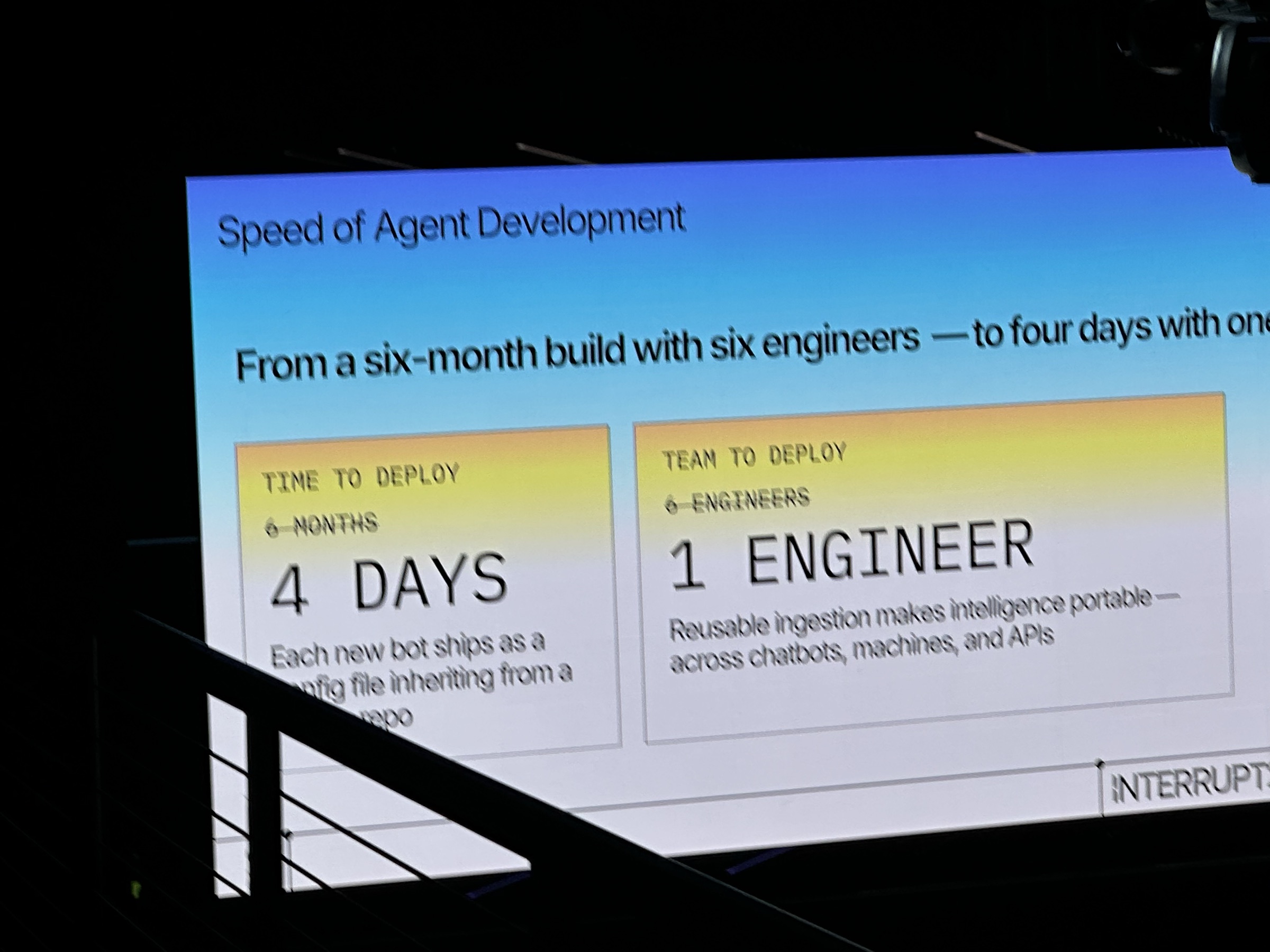 Speed of agent development at Toyota: from a six-month build with six engineers to four days with one — reusable ingestion makes intelligence portable across chatbots, machines, and APIs.
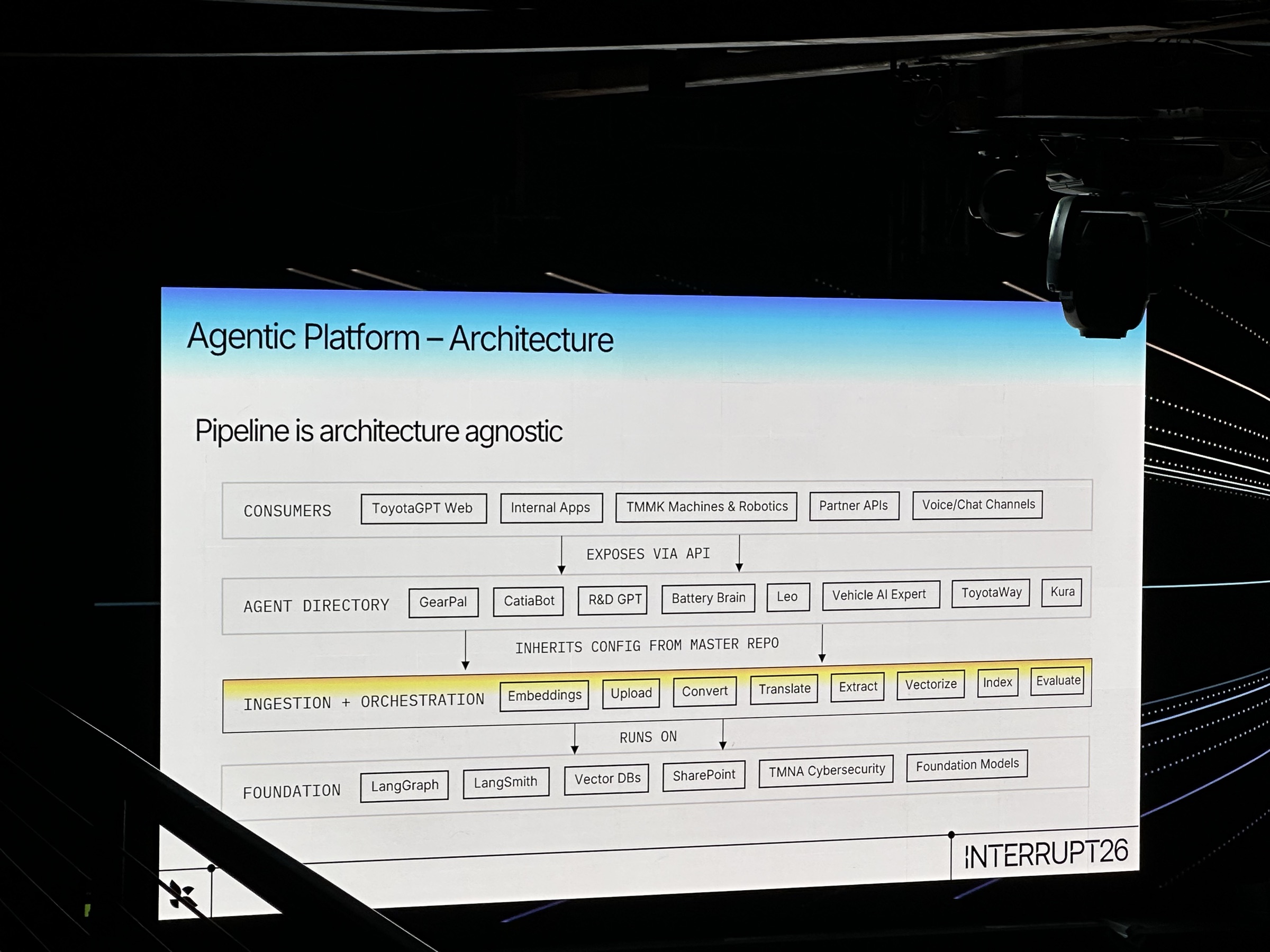 The architecture-agnostic agentic platform: consumers (ToyotaGPT, internal apps, TMMK machines & robotics) over an agent directory (GearPal, CatiaBot, Battery Brain, ToyotaWay…) running on LangGraph, LangSmith, and vector DBs.
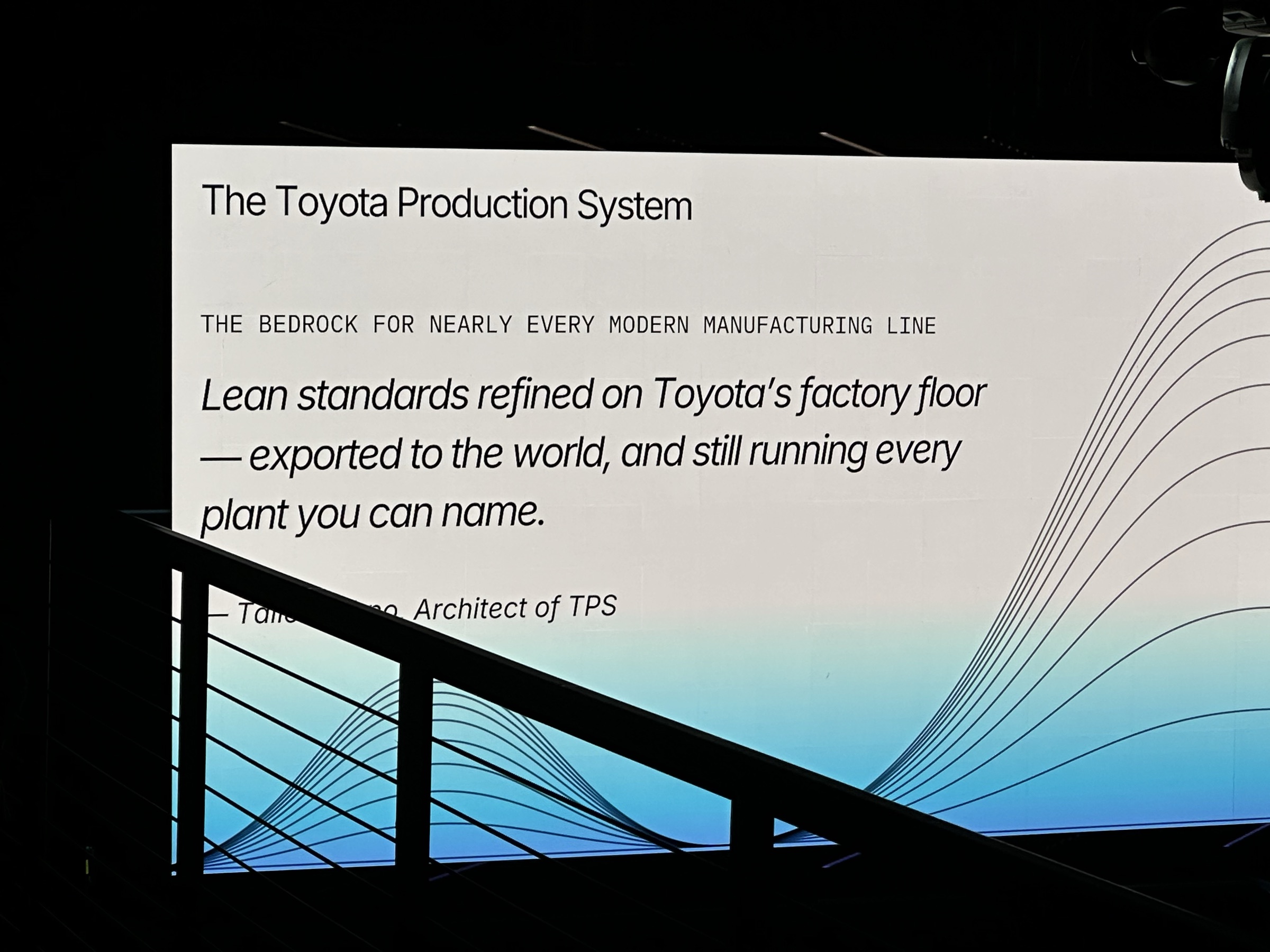 Grounding agent manufacturing in the Toyota Production System — the lean standards refined on Toyota's factory floor and exported to the world.
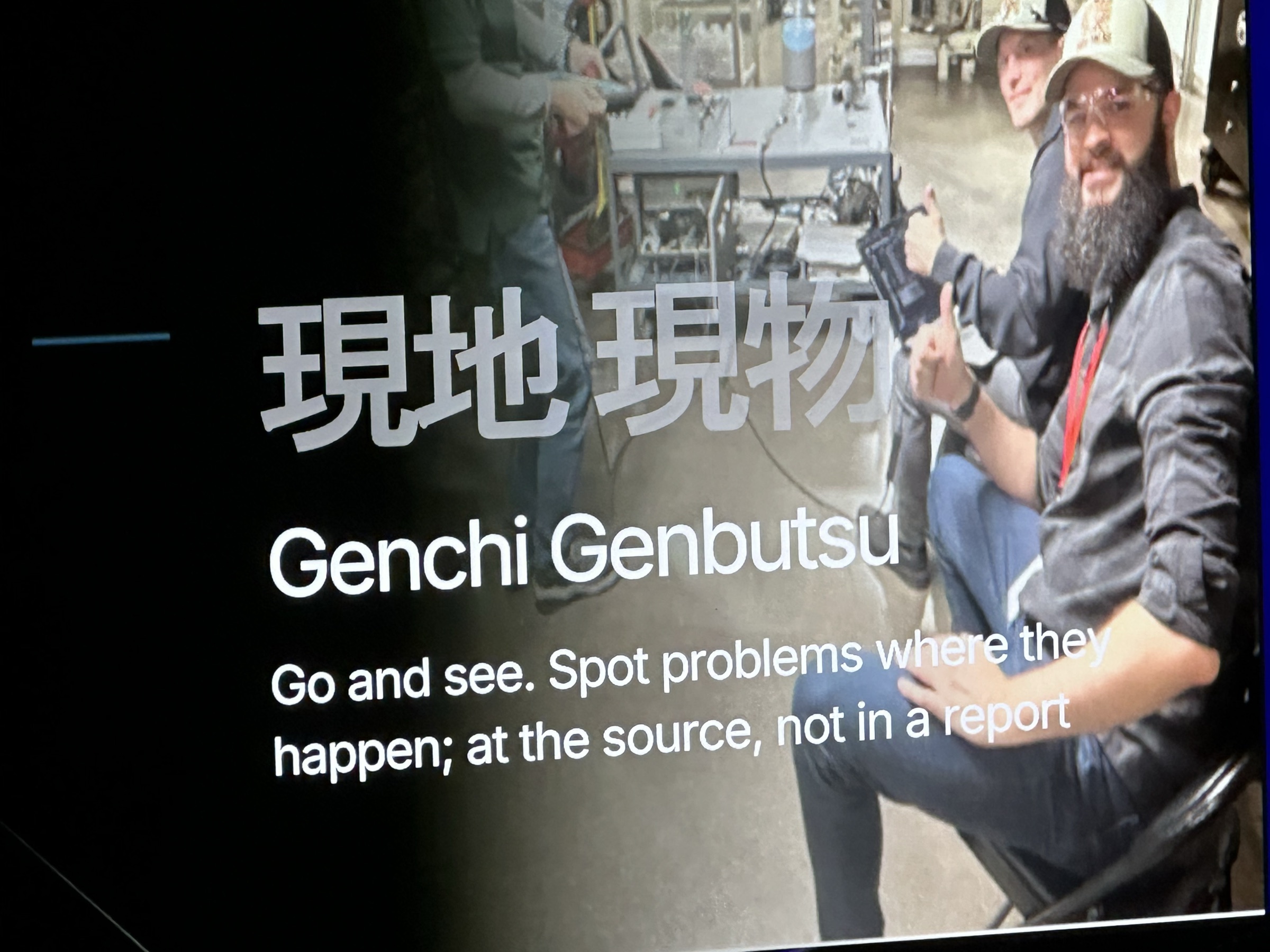 現地現物 / Genchi Genbutsu — "go and see": spot problems where they happen, at the source, not in a report.
Full Transcript
Show the full timestamped transcript (auto-generated; lightly cleaned)
[00:00] Hello everyone. We are the company that is responsible for AI. So if we look at the general AI, this
stage world, inside Toyota, 65,000 people, all of those batteries, and one question that we have is,
what do we do? We are the enterprise that actually, through AI, through stages of wind production,
comes from. So one planet, one platform, nobody else is able to do it.

[00:31] The problem is, nothing existed before that we want to do. So we opened up a black box, we got it
out, and built it ourselves. So this is the story today that we are talking about. I'll show you how
we built FreireGene, a platform that ships AI agents in very few weeks. And Koto talks about tax
with the algorithm. And how 9G, 9G, 9G is really useful today for systems.

[01:01] So that part really surprised me. So in early 2023, every team at Toyota, Rasmus and I built our own
platform. Same position, same instruction, same pipeline, multiple things are coming up. So no
security standards, no artificial standards. You don't need to get into high stakes. So what we
stopped doing. And our job was to stop that. To be the platform, to be AI agent, the pressure was
real.

[01:32] The timeline was just right. So what we could do, we could go for all that. So, one drag that I
bought at Toyota, used to mean six engineers, six months. In the early days. Not because AI was
hard, because everything around it is hard. Security reviews, like with the sign-offs, and ingestion
plumbing, across multiple data sources. And we built from scratch. So our delivery was fucked in
months. That time, we decided to close it.

[02:02] So four days, we built an annual graph based on those online graphs. Given the use case, given the
data access, the entire graph was built automatically. So react agents, deep agents, everything
plugged in. So no security, no artificial data. It's all reviewed. It's all reviewed at once.
Because the artificial ever changes, security ever changes. The only difference, every AI agent we
built, is a second time.

[02:34] So six months became four days, six engineers became one. That is our confirmation. That's the whole
reality. So, the thing that kills every AI agent before it even starts is the excitement. The bad
text is, the bad text is out. Our data is good. Our data in Toyota is brutal. PDFs, Word, Excel,
Cache Files, AutoCAD, you name it, we have it. Scan manuals for 9 weeks.

[03:04] Toyota tables inside tables inside tables inside tables inside images. We have complex data sources
that we have in Toyota. Because we have just needs, we have needs, we have a lot of information. You
name the format, we build the next batch of formats. We have the layout, the way it's passing, and
who's the other person. Team mapping, every source, one unified. And we build it ourselves, 30,000
files at once. So, line up the code, 9,000 pages for the framework.

[03:39] 9,000 for observance, SharePoint, and the cybersecurity team, they came from day one, working with
us. Every agent, then exposed by API. Web, the labs, faculty machines, robotics, which uses Dynar,
the Dynos, which are like vision language action models. And everything runs on our own. The
pipeline grid, Dynar, and M2M, moves dynamically by source type.

[04:13] But the question I want you to take home is this. Are you ready? We have a unit, a single unit of
intelligence. We don't do things nobody else does. One, enterprise gate skills, shared across every
agent. One library, no stress, no duplication. And two, we generate skills automatically from
nanostructure data. We have 10 of them that have been added. We need to document the pipeline.
Skills emerge without a single engineer writing them by hand.

[04:47] We want to have a unified tool layer, MCC compatible. Every tool, secure for any AI. You want it?
It's there. Secure? Or enough? So today, over 50,000 agents are in production. Every single build,
content, every one is quantified. From battery drain on the band phone, and to the long-term memory
of the entire enterprise, Toyota way, Toyota's culture and principles,

[05:17] purified into an agent and a clinical AI expert that tells about every Toyota model, every spec,
every history, and all variable techniques. Let me walk you through a few to show you this platform
that actually makes this possible. Gateball. Gateball started as an add-on idea. One of our team
members, James Buffard, had a vision. What if we, if we manufacture in general, could just find the
problem and get the answer instantly?

[05:48] Today, Gateball sits on terabyte of data in our vector data, serving every manufacturing plant
across North America. It's real. It's real-based. A production line, when a production line is
generated, goes down, an engineer walks over to the shelf and puts a manual, clips through the
pages, manually searching all the information, and fixes the problem. That takes hours and sometimes
days. But if a production line stops for a few hours,

[06:20] we use millions of dollars, because we're not taking cash. Today, type the problem, there's a
solution in 10 seconds. From an hackathon idea to millions of dollars savings. That's Gateball. And
it's easy. This is close to my hand. Every color you see in Toyota on the road, we create the
transplants. We create the paint transplants. we leave bear good-looking pieces behind, that's when
you see thevisible hair when they essentially showed up to the surface

[06:51] and went to their perspectonal잔 Every single thing is blurred, and uselessイ We start looking for
problems, and we're never going to be able to find problems. We get rid of the bad things, or the
pleasant, that, happened, and we look for new ones, and the problem is, No compression because of
our own institutional knowledge is now searchable, connectable and queryable within Megadisk. And
then, Steadiacity, the design engine that lives inside the tool design, already uses new car
designs, existing cars in design,

[07:30] can query test practices, find references, identify factors without even leaving their hands. So,
here is a context switch. The AI is just there, the workflow is exactly where it needs to be. When
we started our journey with Hanson, nothing existed with us. We built the entire institution in
format, through PDFs, through KDE files. The line chart media came into the life and then we built
the framework using line chart, time graph and DPH.

[08:02] Time we've done, automatically populated. We built this skill teacher. In that way, the design is
now a part of the process. We built the tool layer, MCPR, enterprise sector. We took a hackathon
idea and turned it into a telehealth of production. 50 agents, multiple logs of sales. Wealth from
zero, from scratch. So, we learnt every single thing that's happening. So, we didn't wait for the
industry to catch up. We went ahead and built it. So, now, the total is going to show us something
genuinely surprises everything we've done.

[08:34] Toyota invented a philosophy behind the technology. I think, back before 1988. Go ahead. Yes. Toyota
is arguably the best auto manufacturing in the world. By extension, one of the hardest and best auto
manufacturing. And it got there through something called the Toyota Production System.

[09:04] The Toyota Production System is a system that is based on the idea that the best auto manufacturing
in the world is the best auto manufacturing in the world. The Toyota Production System, or TPS, is a
philosophy, a framework for building a lot of anything really, really quickly and with really
minimal resources. So, by extension, it's a philosophy on how to build vehicles, manufacturing line
with very lean lead, with minimal staffing, minimal resources. Make manufacturing line modular. Make
it robust so that it's amenable to breakdowns and keep continuous flow from raw materials all the
way out to the end.

[09:34] The principles for TPS are really the backbone for any steel, hardware manufacturing line we see
today. It started with Toyota. It fashioned over the course of almost 100 years. But really, it came
formalized in the 80s, as Robbie mentioned, in order to help Japan, who had a lot fewer resources
than North America, compete in North America in auto manufacturing. And TPS is kind of the backbone
for all the work manufacturing today.

[10:09] And we see a very similar manner on TPS with lane chaining. Lane chaining is the modern backbone for
the equation model. Next generation software, any types of workflows will be manufactured.
Principles for hardware manufacturing translate really well into agent manufacturing. It's just a
matter of substrate for the amount of manufacturing. And so this has been a really pleasing and
quite awesome experience. I don't need to use lane chaining products to become more embedded in
their ecosystem because they embody the ethos from which Toyota was founded and all of the
principles that our team shares that we work with every day.

[10:50] So a couple principles of TPS that are pretty obvious to identify with lane chaining is the end on
board. The end on board in manufacturing is a way to... see what's going on really quickly without
having to survey the whole manufacturing board. What's crumbling down? What needs supplies? What's
going well? Where can I allocate resources in order to bolster another part of the manufacturing
line that's dwindling? And lane chaining is the literal embodiment of an end on board.

[11:20] We can see observability over all of our agents in real time, understand what tool calls are
working, what features should be focused on for the next PR, the next product release. And we can
see the end on board. And what's going well with our users? What are the frustration points? How do
we better serve our users and appreciate our software? Lanesmith is the direct analog for the end on
board. One term you're all probably familiar with is the term Kaizen, which is continuous
improvement through slow and steady, but consistent modification.

[11:55] And the software engineering culture really embodies that. We're always pushing PR. We're always
bolstering new products. And we push updates regularly, sometimes, you know, nightly. The great
thing about Kaizen is that from a lanesmith perspective or a lane chain perspective, there's really
a macro level that Kaizen is being implemented and a micro level. From a macro level, the software
is always improving. Harrison just announced a bunch of new features today that are going to be a
huge advantage to the ecosystem that's already been published.

[12:28] So, on a micro level, there's agents that are continuously improving. A very rudimentary example
might be ReactMe. Something that's always monitoring its output and continuously improving to make
sure, before it presents to the user the final response, it's actually correct and it doesn't lose
their intent. So, this philosophy of continuous improvement through steady changes and changes is
something we embody with Toyota and we're delighted to see with the lane chain throughout the whole
industry. My personal favorite is the principle of Jidoka.

[13:02] Translated literally, it means automation with a human touch. And what LaneGraph does really well is
it automates a lot, it hashtags a lot of the nuances and nuance that, as an engineer, I don't want
to have to deal with or I don't care to deal with. But it keeps me in the loop. It keeps me plugged
in so that I still have value as a human and I still got the product. I just need to develop it and
deploy it. And I think that's really important. Jidoka is really like a handshake deal between AI,
automation, and a human to say, I understand each role that you play and I understand we're going to
have to adapt as technology progresses.

[13:38] On a manufacturing line, Jidoka means that a human understands we need automation in order to
manufacture things very leanly and very efficiently. But as technology evolves, a human's role will
change because that automation will change. But humans are critical to ensuring high quality
products. And delivery to the product customer. So, LaneGraph is literally the audience of Jidoka.
The next term is Genchi-Kinbutsu.

[14:09] So, this means to literally go to the source and understand what's going on. Try to figure out the
root cause of the problem. Like, don't just, you know, don't, we can't figure things out on our
teams alone. There's a manufacturing issue in Texas. You can't sit in California and try to figure
out what's going on. But the best way to solve the problem is to go to the manufacturing line.
Actually, touch the hardware, understand the root cause of the problem, and then throw the great
solution throughout the rest of the manufacturing line that we present, the remedy. Placement traces
are a direct embodiment of Genchi-Kinbutsu.

[14:43] For every query that I have, I can see the entire trace, the entire route to the solution, and, you
know, if there's an issue, I can see exactly what caused it. And so, it brings out Nyanhan more. It
brings out the entire network by giving me a direct insight into what the problem is for any one of
my products, my products, my agents. And it helps me as an engineer not have to sit through bombs or
spend a long time coding. I can go directly to the problem, try to solve it, and keep our products
up and running for our customers.

[15:14] LendChain is a direct embodiment of the point of purchase philosophy. And while the framework is
timeless, the TPS is the bedrock of hardware manufacturing today. It hasn't been well translated
into software or into manufacturing agents, but into LendChain. LendChain is the carrier's legacy of
TPS forward to allow all these principles to be carried over into manufacturing of the new era of
software engineering.

[15:50] And so, I'm really excited to see where LendChain is going to go, because our cultures are so
similar. And I fully believe that in the next few years, and actually probably now, the entire AI
industry will look to LendChain as the TPS or the LendChain production system, the bedrock from
which all these SaaS services, companies, etc., the entire industry will come. Thank you. Professor
Gazzanis, thank you very much for your time.

[16:28] And Raghavan will be available for any questions you may want to have after the session. But, yeah,
thank you.