Building Frontier CX Agents – Cisco
Speaker(s): Carlos Pereira (Fellow & Chief Architect, Cisco)
Session: Interrupt 2026 · Day 1 (May 13) · ~10:30 AM PT
Source: in-person audio recording, transcribed locally with Whisper large-v3.
Summary
Carlos Pereira, Cisco Fellow and Chief Architect for Customer Experience, recounts how Cisco evolved its agent system over the past year from a chatbot foundation into a 'teammate' that delegates and proves value within real business workflows. Operating against Cisco's $56B business (more than half recurrent revenue) and the land-adopt-expand-renew lifecycle, his team replaced a brittle supervisor-routing model with dynamic, plan-based supervisor graphs where each stage decomposes into subgraphs that can re-plan and reflect. A key lesson: 95% accuracy was not enough; adoption plateaued because the tool sat outside users' daily workflows, so they pursued personalization and 'forceful curiosity' to embed it. He warns that putting AI on a broken workflow just reaches the broken state faster, and argues for AI-native workflows judged by ROI/outcomes rather than raw performance, with deterministic task-based planners for steps that must follow business policy.
Key Points
- Cisco is a $56B business with more than half recurrent revenue; CX organization is roughly 18,000-ish people running a land, adopt, expand, renew process
- Evolved from a guided chatbot foundation to a 'teammate' model focused on workflows (which run the business), not just agents; runs in production at scale with open prompts available to all workers
- Agent foundation combined a Renews agent, Sentiment analysis agent, Adoption agent, a Discover agent, and a traditional ML risk-prediction model to reach 95% accuracy
- Replaced a heavy supervisor with a dynamic plan: supervisor graphs route on metadata/policy and create plans with stages and steps; each agent (e.g., reviews) is itself a supergraph with its own planner, reflection, and re-plan loop
- Supervisor must stay as lean as possible (route on metadata/policy) rather than becoming thousands of lines of code; LangGraph routing handles this well
- Deterministic, task-based workflows (slash-command scheduled tasks) are used where reasoning quality isn't reliable, because few-shot planners get creative and inconsistent across runs
- 95% accuracy plateaued on adoption because the tool was 'yet another tool' outside daily jobs; fix is personalization, embedding into workflows, and 'forceful curiosity'; mindset shift: 'humans help software to get what they want'
- Six agent-infra lessons: start bounded then extend (let the agent draft before it acts), self-correction is not optional, observability is a no-brainer, invest in quality/knowledge upfront, the model is a helper not the policy, and routing is your first decision
Notable Quotes
If I have a workflow that's broken and I put AI, I actually get to the broken faster.
Until now, until before, software helps humans to get what they want. Our mindset now is 180 degrees fluid. Humans help software to get what they want.
Self-correction is not optional. The difference between a pilot and a production is when you have this actually, have the agent fix its own output.
Slides
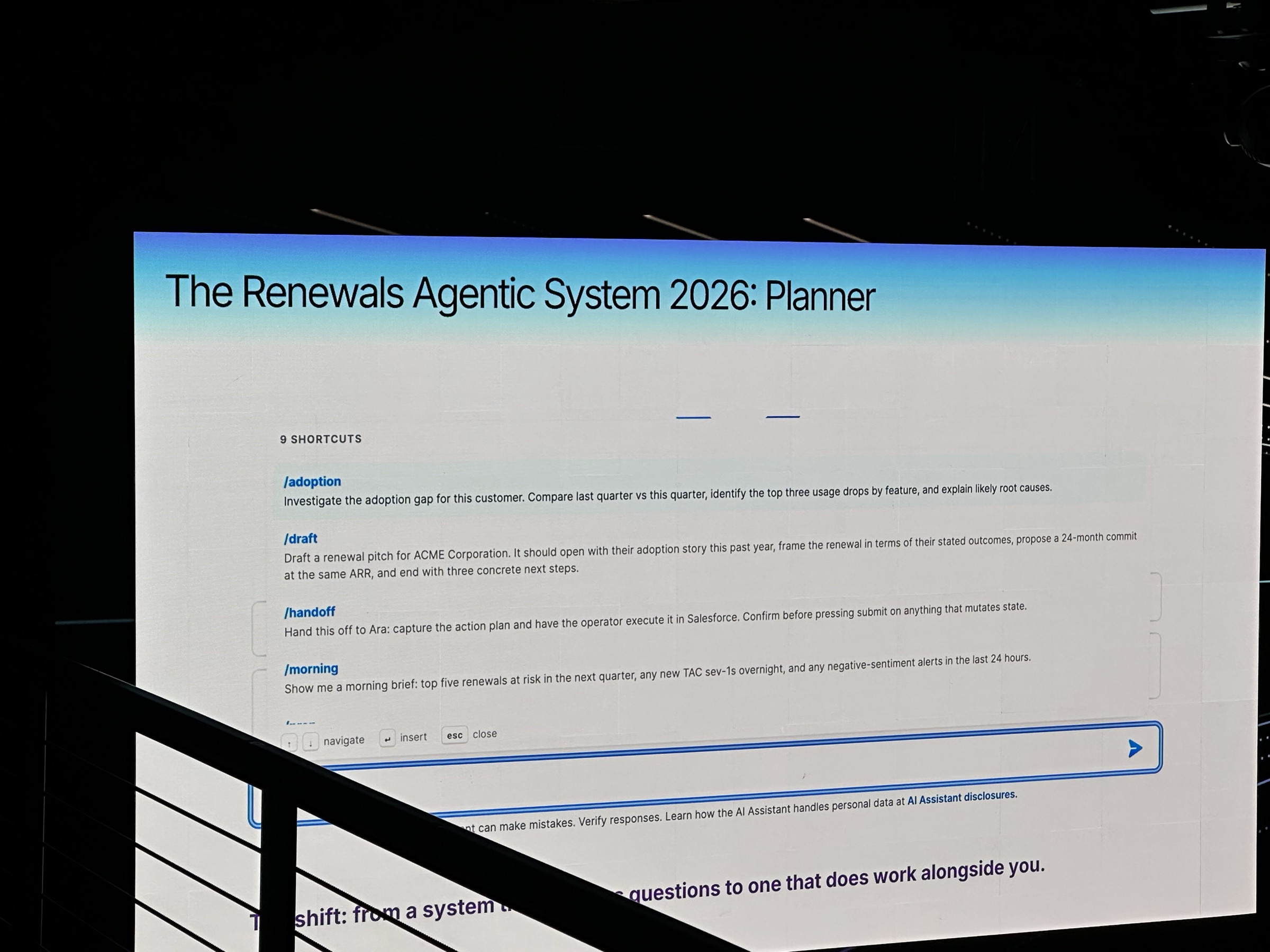 Cisco's Renewals Agentic System: a Planner driven by slash-command shortcuts (/adoption, /draft, /handoff, /morning, /qbr) — the shift "from a system that answers questions to one that does work alongside you."
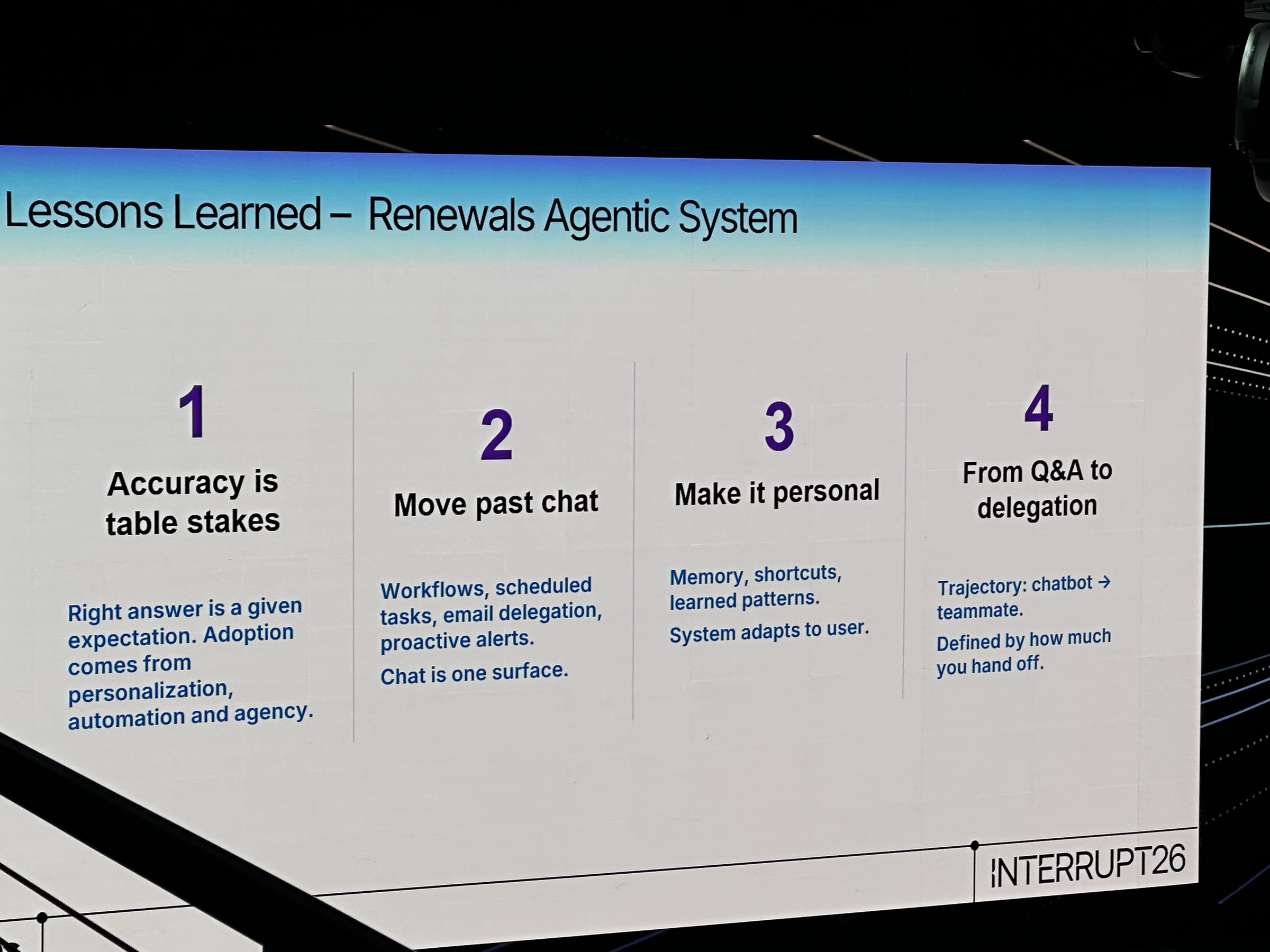 Lessons from the Renewals Agentic System: accuracy is table stakes, move past chat, make it personal, and shift from Q&A to delegation.
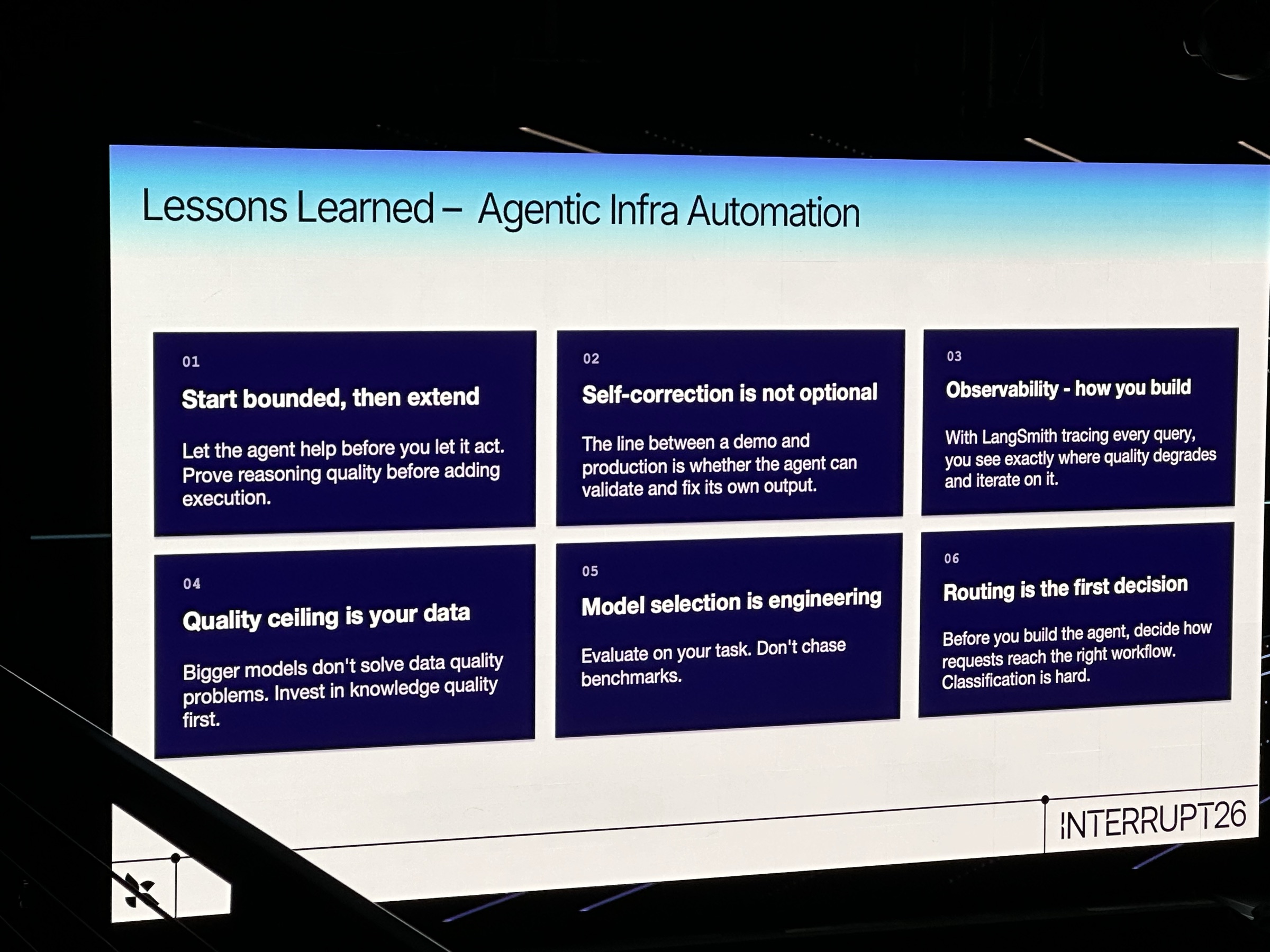 Six agentic-infra lessons: start bounded then extend, self-correction is not optional, observability is how you build, your data is the quality ceiling, model selection is engineering, and routing is the first decision.
Full Transcript
Show the full timestamped transcript (auto-generated; lightly cleaned)
[00:00] Good morning everyone. Thanks for having me here. I was backstage watching Ankush and Harrison and I
was like, wow, how many of them are here? This thing hasn't been easy for the last time. My name is
Carlos, I'm a fellow and chief architect at the customer experience inside Cisco. I'm a recurrent
speaker and the idea for today is going through the last 10 minutes or so.

[00:31] It's a very high level agenda. So what is AI and Cisco all about? So that's one slide to set the
context. Then we go and talk about the renews, the genesis. For the people that were here last year,
I had a session that explained how we do the genesis for the renews business. For the context, Cisco
is a $56 billion business. More than half of this is recurrent revenue. So this thing is in terms of
all the recurrent revenue of the company.

[01:01] By the way, we are now seeing earnings today, so hopefully we do well. So that's a very interesting
thing. And then we are going to share with you lessons learned not only on how we approach the
renews as banks, which many of you last year came up to me like, this problem I have the same way
myself and my company. And what we did with our traditional infrastructure. So you don't have to do.
Don't worry. So customer experience in SAP CITIES is an organization of about 18 to 10,000 people,
depending on how we look at this. And we have a very standard process of lend, adopt, expand, and
renew.

[01:35] Then there is a bunch of teams on the list that are in charge of those tasks. Lend is pretty much
anybody that buys something from Cisco. It's a SaaS service you start to use right away. But if it's
a piece of hardware or a main of those, there is someone that needs to know that they write this tag
and who they gave it to and all of those things. So we have the delivery team, the professional
service that starts the countries to make this work. And then our new customers of ours that are
multi-geo regions they have in Europe, Asia, and the U.S. Then we go for the adopt.

[02:06] We have a business success organization that their only task that they have is a multi-thousand
people organization. That their mission in life is to maximize the value of the investment that
someone did in the system. So if someone bought a high-tier license and is using the basic
functionality, go there and make sure it works. So we use AI to predict that as well. And if that is
the case, we usually enjoy expansions of the use cases and stuff up to a point that we get the renew
cycle and end of the tunnel. Everything is good. We didn't mess up.

[02:36] The customer is not pissed off. We really get something to do with that. So when you look from that
lens, back in the day when Harrison started the company was the DDT kind of wall effect. And
everything was made for shot DDT. But that was a business to consumer kind of thing. Our clients and
customers experience were more B2B. So we start with the shot quads kind of thing. But if you go to
the session that I presented last year, you saw that we focused on how we define prioritizing use
cases as opposed to go after the height.

[03:08] So last year, the whole thing was about the Gen2Ki. Everybody was talking about the Gen2Ki, how it
connects with the whole staff, the customer, the patients. And you talk about orchestration. We
believe that many things things is the year where a lot of corporations like yourselves, a lot of
companies is going to start to do this work. The logic is the following. A lot of the business runs
with some workflows all day. The main ones have been created years ago. Which means that a lot of
people using AI to form events, that's a nice way, is usually both on.

[03:43] AI and some of these workflows to claim victory just based on efficiency. Is that right? It's more
cost effective, it's more speed effective, it's more whatever effective. But here, many times,
actually, on our case, if I have a workflow that's broken and I put AI, I actually get to the broken
faster. So we realize that we're pissing off customers sometimes faster than we used to be with AI.
So I'm not joking. This is reality. So it's time to look at how we recompose AI-native workflows and
use ROI different methods to judge success.

[04:18] As opposed to just say performance methods. With that in mind, we now realize that the majority of
the value that can be measured is when you go after AI-native business workflows and leverage
technologies like the ones that got announced by Harrison and Bush to make this happen. But the
reality, the majority of the companies are still transitioning from the shotcots to the intense AI
to some extent. So how did that happen for us? In 2025, we had money in production. We had a chance
in foundation.

[04:49] We didn't have SmithDP. I have so many ideas for the team that we're going to go after that. But
outside of this, we have the agent foundation, which was a multi-agent space of shotcots interface.
Initially, we have a guided interface, so we used GenAI just for the answer. We didn't have this for
the questions because the Renews team gave us what they wanted answers for. That lasts like three
months until they told us, I don't want to be slaved for an interface. Leave me open for it. But the
main goal for the days of the beginning was actually to earn the trust of the team to use the
system.

[05:22] But soon enough, we realized that this alone wasn't enough. And we evolved the system which is
running to learning production, which is the notion of a teammate. So the idea of a teammate is
actually focus on the workflows, not only on the agents, because the workflows run the business. The
agent needs to be an instrument to get there. And the idea is how you get this teammate to delegate.
To receive some tasks and be able to prove value out of this. So that's what I'm going to go into
details a little bit more here.

[05:52] So we have it running in production at SCADA today with open prompt meaning anybody can type
anything. It's not kind of guided. And you have it available to all of the workers. So let's type a
little bit more. So last year, I showed to everybody how we do the agent foundation. So we have
Renews agent. And you have a Sentiment analysis agent because you pick up the speed of the
likelihood for the decreases. And you have an adoption agent because the higher the adoption, the
higher the likelihood of the renews.

[06:25] So that's easy as a given part. We have Discover agent. It's not an on-prem sitting environment
using multiple models. And we also have a machine learning risk prediction model. You know very well
that other types of predictions don't get along very well. So we do the ML model, traditional one,
high-level predictions. So that combination gave us 95% of accuracy in a lot of good things. And we
said, you're all set. Partitions is on the way. It didn't work like that. So we need to approach the
notion of the Renews team.

[06:57] And that's where a lot of interesting things happen. What you realize is that the supervisor, you
start to actually get more complex. And you start to get more combinatorial, more questions, and
more analysis. And the reason that needs to happen. So we need to introduce the notion of a plan.
Something that the orchestration based on the context of the question will need on the spot to
create how to plan the decomposition of agents and suit tasks. It's an interesting thing because the
better the models get today, the more reasoning they have, the more creative they get as well.

[07:35] So then you can get out of what the business is required. So from an architecture perspective, we
have a couple of things. We have a user interface, not only the chat box or the UI. We have this as
an API. We have other systems that can do that. And you go for a supervisor graph. And the
supervisor graph, actually the plan, I think, events the stages. And every stage can have steps. So
when we think that step, you go. And everything is OK. You move on. If not, you need to re-plan and
come back to say, hey, Mr. Supervisor, your analysis of the plan.

[08:07] And the plan didn't go as planned. So let's re-plan it. So everything is OK. And then from that, you
go to agent player. On this example, we have reviews, adoption, and sentiment, as I mentioned. And
then now if you select the review section, the review section itself is a supergraph. So we have a
planner inside itself because it can have multiple relations. And you see how this becomes
recurrent. And you can see how Bush and Harris was talking about length. Lengths become more and
more interesting.

[08:38] So if I go for this, what change? Instead of having a supervisor teaching the agents, we have a
notion of a plan. It implies some changes on a production at scale. Again, I'm talking about here,
$26, $27 billion of it. So you cannot mess around with this kind of thing. And you talk about the
scale. So the supervisor gives this high-level plan that masks tasks for patients or subgraphs that
come to that patient. It is not an oracle. It's not something that you're going to quote your file
on the phone.

[09:09] It's not going to defy all the policies. A lot of the training for people is like, hey, I have a
supervisor. The supervisor is smart. So I have a task model out there. I make it work. And then the
supervisor becomes line, some thousand lines of code, and realize, hey, it's not working. So make
the supervisor as leanest as possible. It just needs to think metadata. Policy helps you route. And
you can map and then graph routing for them, which is very good for this. Then you have an
introduction of a review.

[09:39] And then you have a plan for how the case will be. Your case will be whatever plan your business has
planned. And the plan breaks down the questions into smaller tasks for the subgraphs. But it's not a
container where you put a bunch of queries on SQL and a bunch of stuff that you try to steer the
other end. Because what's going to happen is going to go down in the books. Do you agree? And last
but not least, as you start to navigate, on this case, I have renewed on the left. And I have
sentiment and adoption on the right.

[10:11] But if I go and zoom out one of them on the left-hand side, another prototype detector that has a
plan and exit inside that. So it decomposes on subgraphs and goes into it. Let me give you a little
bit more detail. That's zooming on the superbox. Here's a question that a typical reviews person at
Cisco would ask. Hey, can you give me what are my top ten customers by ATR? Or the Q1 fiscal year?
And what are some of the things that we have trained the same? That have pool, which is a product of
ours, could be a switch or a rubber or something.

[10:43] Along with the sentiment of . It's a very detailed question. And a lot of conflicts of interest. So
the first thing that we realize, just having the supervisor routing from the engine is not enough.
First thing that we need to have the supervisor dynamically generate is a notion of acronymism . So
what does ATR mean on that context? ATR here means availability. So it's not a renewal. But it can
mean something else in a different context. That's as basic as this.

[11:13] And you start to go for this if the supervisor actually dynamically creates a plan. On this case,
you realize that after it doesn't complete what ATR means, they realize, oh, I have stage one that
is renewals. Stage two is sentiment. One is dependent upon another. So it actually creates that
plan. It's what the sub-agent seems to go. And what the context needs to be here. And then it's
going to point down, on this case, for that input card on what the review is versus the other two
parts.

[11:48] If I go down a little bit, you're going to see that in order to go there, you establish length graph
with the plan. You use the same execution with that graph. And then if everything is OK, you
summarize the length graph and go to another . If it's not, you need to do replan. And all the
length graph. This is all dynamic. And that's the deal. You don't need to modify everything. Because
introduction and the median speak to you at the same time. You just don't know. Right?

[12:18] So if I go deeper, we go now to the plan. So the plan then heats here on that state on the renewals
on my left-hand side of the slide. The same would apply for sentiment adoption. But let's go just
for one. If you look at this, when you get to this supervisor's point, this supervisor that heats
one of the tests, I have few shots examples. But we think that to graph, I have now a renewals-
specific plan. So it's like a supervisor mindset, if you will, that applies just for that agent.

[12:53] Because we think that agents, there are sub-tests that needs to happen. I'll give an example.
Remember the question that asked about the Q1 to this W26? There's no way they have a demo. We don't
know how the fiscal year or fiscal runs. So which month or which month, which might go up there.
It's going to be different for every company. Right? So we need to go from there. And there's a lot
of sub-tests that we decompose. So we think that agent was supposed to be a monolith of agents. Now
we open up and we have a plan in service.

[13:24] And that plan is going to define how we plan for sub-agents within that context. And if you click on
the bottom, you have a reflection slash re-plan. Re-reflect. Is that state and the steps okay? If
yes, it gets out. Go to the loop of the supervisor that has its own reflection and re-plan. If not,
it's going to be until it gets to the threshold inside the state. So you realize the evolution of
how to make this more scalable at massive scale

[13:55] and a parallel execution. And by doing so, you can be ready and happy with one of the sub-tests. But
as you go to the supervisor and the re-planner, if a question implies a re-plan, it implies multiple
stages. And the reflection of the re-planner would be triggered by the running site or have the
supervisor act on multiple times. Why I'm sharing this with you? Because as you start to get more
complex about the questions or more input for something like the length needs to give you more
context,

[14:26] if you don't have an architecture that's scaled like this, you're going to have a lot of issues and
a lot of errors. So by doing this thing, how do you do this? How do you do this? You build your
domain specific sub-graph and you have a workflow engine that needs to be put here. And that is a
challenge that we face that we address in a different way. Which is, if I give a planner, let's say
a few shots on the supervisor and say, hey, follow this test. Beyond the weatherman, first time he's
going to follow this test.

[14:59] Second time he's going to get creative with the five steps. Third time he's going to get for four.
Then he's going to get four states. He's going to divide it to you. And he's going to have debates
and arguments with the other level. I've taught myself to do all that. Okay, let's prove this. Let's
not even go there. When you go for a deterministic thing, what we did, we actually adopted a notion
like all the coordination tools have. Like the protocol, the products, and cursors. So we create a
backslash and we actually create schedule tasks that are very deep

[15:30] on what needs to run. Behind the scenes, whenever you have a task, every months, something should be
back liked on your profesionalized elements set up. If you are scared of st흠?! Then you will not
afraid of the avoiding what needs to happen. Last time here I thought, c'mon, man, don't stand up. I
really wouldn't be worried about stΛ?! So te k

[16:02] 40,000РИ at the time why not? It doesn't mean it's convenient. It takes you to places. That's it. If
you go to NCP, it takes you to NCP. It's the same thing. So, think about this. QPR. QPR is working
business review. If I pass QPR to the model, most of the time it's going to ask me, hey, I don't
understand how your business runs. Can you teach me how it's going to be for your QPR? But if I go
and put a new course, which is something we run in our business, oh boy, then in the end, it's going
to be all voluntary decisions.

[16:34] Hey, the post runs here, the view runs there, how we should do this. I said, well, you pass the
opinion, my friend. Just do what needs to be done. So, in the planner, we have workflows that are
deterministic, task-based. So, this is programmatically done. Then if not in the end, we put the
reason we put on text because I want them to follow instructions the way they listen because that's
my full business. Everything else on the planner, we plan it and all of that goes together. Okay.
Well, one last thing I want to touch on.

[17:04] Last thing we talked about is the foundation. We have 95% accuracy, a lot of users, many queries a
month, all the right things. But then one thing happened. We asked after answers. We got us
adoption. But we plateaued. A lot of people used, tried a handful of times, and then they lost it.
So, we are scratching the head. I don't have enough head to lose, so I'm scratching it. I'm like,
what the heck? What the heck just happened here? Why is the problem is you guys go in and they don't
come back?

[17:36] Right? And they come back to the spreadsheet and say, like, two Gs. Really? We build this for that.
So, we start to figure the difference. So, one thing that I would share with all of you for free,
there is an ocean of optionality. The renewalization for Ed was yet another tool. He was not
embedded on the workflow and tasks of their daily jobs. So, they have an option to see this, but by
the human nature of the laziness of the

[18:08] homo sapiens, they use this to information and go in the work back for their comfort zone. So, we
work on a concept inside Cisco CI that's called forceful curiosity with the management to actually
get them there and at the same time, consolidate the data. And the second thing, he was actually
informed to the teammates. So, he needs to get out of the chat only. He got many things as a
collaborator and for me, and for that to happen, he needs to be personalized. Which led us to focus
on everything that's the guy needed.

[18:40] Why? And we expect this to reduce the whole CX organization. And it's an interesting for you that
we're working on this now. Until now, until before, software helps humans to get what they want. Our
mindset now is 180 degrees fluid. Humans help software to get what they want. And the reason is
because we're not asking the question, how can AI improve existing software or sense work for us to
ask, is that work for me or not?

[19:10] And if I would solve that outcome, would I solve the way it's solved today? Why? Because we are
thinking about evolving from what the AI is used for a system to AI to commit to results. My nature
results included. On such a way that instead of having systems that are not working, we're thinking
about how to step-based the workflow. It's typically how workflows work. Step one leads to step two
leads to step three. It's very sequential. To get AI execution of an authority, then instead of
focusing on workflow logic, we

[19:40] focus on the context. Because the context allows parallelization. In such a way that we give
autonomy by default, the whole workflow is AI driven for execution, and it only stops that based on
confidence scores, which is calculated, as opposed to augmenting with AI every step, which is
molding form. So the humans, after the confidence score is treated, is jump in for judgment, as
opposed to what is today, the majority of workflows has human DNA, but human kind of orchestration

[20:15] by DNA or how it gets used, and maybe. One observation. The people that we are asking to change is
the same people that knew this workflow for many years. And they remember this. So, we expect some
resistance. I'm just kidding. So, some, just to wrap here, the top things that we put that allow us
to perform for the chatbot to a team-mated delegation target, the authentic system, I would
highlight the long-term memory. There's a lot of bank chain contributions on that.

[20:47] The scheduling tasks, all the shortcuts that we mentioned, and Nathan Kavishan's project. And let's
go down this, here's some of the lessons learned. I'll take the lesson from two angles. One, the
system itself. Accuracy is stable state. So, we have 95% accuracy. We believe that was enough. It
wasn't. We think that's stable state. We need to build agency and personalization for adoption to go
higher. Move past chat. Chat is just one service. Be creative.

[21:17] Be came with the workflows, the scheduling tasks, the main delegation, the whole many arts, which
makes adoption and business much better. Make it personal. By that, you make the system an adaptive
user. Not our labor. Not trying to steer the user just because the system needs that function. The
mindset needs to change. And delegate for Q&A to actually something that defines how we handle it.
This year, I actually brought with our team, I said, hey, this is enough of a long lesson

[21:48] learned for how the system works. But there is another layer underneath. It's the agent-infra
automation. How do you go underneath to make this happen? So, these are the six I would share with
you. Start bounded, then extend. What I mean by that, let the agent tell you before you let it act.
So, what I mean by that, the reasoning quality not necessarily is there for all the things. That's
how we end up with predictive workflow which is deterministic because the reasoning

[22:19] was a piece of that there. So, like, use what is good for before you let it go. Before you let it
go, let's get your draft. Self-correction is not optional. The difference between a pilot and a
production is when you have this actually, have the agent fix its own output. One way that
observability is a no-brainer. We're going to talk more tomorrow and some of us should go in deep.
We can hit him on that. And the last goal here is quality is a friend. And quality, to me, is
something that you can invest in knowledge upfront, including

[22:50] on the model. So, retain the rule and most smart model is going to solve your problem is a policy.
Don't think about that. The model is a helper. Don't change benchmarks. And last but not least, I'll
leave it to you, routing is your first decision. Before you do the aging, decide if you think about
workflow, how to reach the next step of the workflow because that classification is hard. And
without doing this, the models will lose it because they don't know the rules. With that said, I
hope you enjoyed this.

[23:20] I hope it's helpful and show you how we evolve in one year and how much in another year they can
change. Thank you very, very much.