The Servers are Defective. They Hate the Tools!

Over the past year, most AI developers have learned how to configure their coding environment — optimizing for third-party packages, specialized processes, and personal preferences by adopting IDE/language/framework-agnostic primitives. MCP jumpstarted the context engineering revolution. In its infancy, even the experts had their fair share of complaints and points of confusion. So it's comical that the next major innovations centered around simple text files like AGENT.md, CLAUDE.md, MEMORY.md, and SKILLS.md. Exact configurations, formatting, and file structure may vary between providers and skills marketplaces, but overall, with the exception of bundled scripts for skills, most .md files are universally compatible between different systems — no coding required.
This is where things get interesting. When I decided to leave my corporate job to do AI all day, I was surprised to be faced with a seriously consequential decision right away. From this point on, my personality and everything I am would be defined by my choice to MCP or not MCP. You know what they say, "you're only as good as your hobbling along agent..." something like that. You're either an MCP person or anti-MCP person. That's it, two options, no room in the middle, you're either in or you're out...
Example Chat Message:
"I just watched a video and the YouTube fella already deleted his MCP servers live on his video and he did it, so must be right for me too...do what he do...DELETE! "

"Next, create markdown files to replace all the MCP servers and tools we just deleted. /ralph-loop" Muwahahaha GIVE ME SKILLS!
Of course, there's also a camp that says .md files degrade agent performance — so now you've deleted your MCP servers and their replacements are also under fire. Welcome to the discourse.
Now, even if you've never heard of MCP, SKILLS.md, etc. but have experience designing, building, etc. really any type of project-based work or creative space, you already know — these things never work that way, at least not for me. See Appendix A for an example of my game-changing decision analysis process.
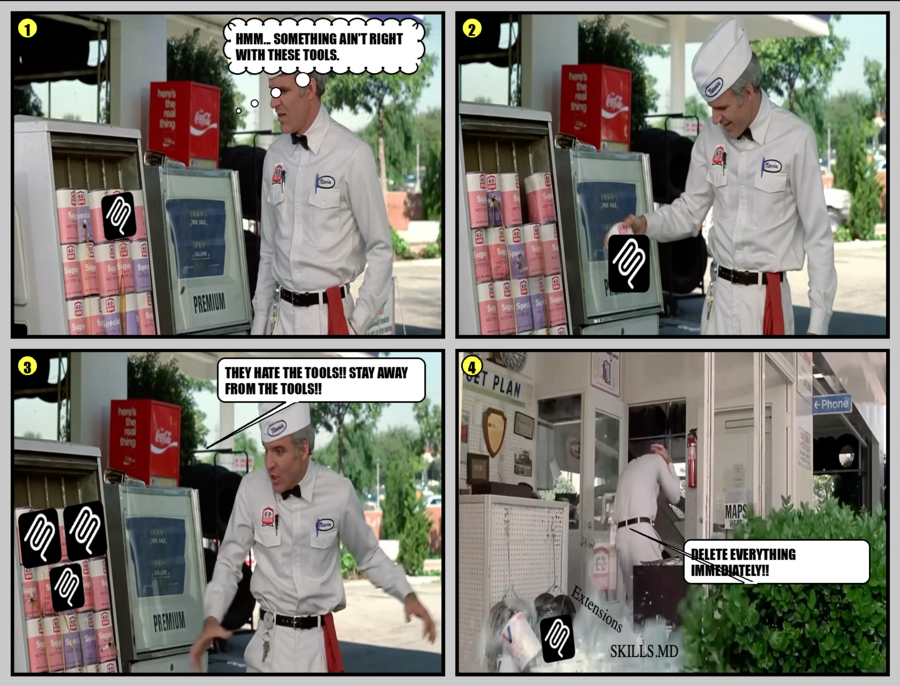
Personally, I'm not going to delete any of the primitives or MCP servers, but when I hear the anti-MCP crowd voice frustrations, I imagine an interaction like this:


David Cramer, the CTO of Sentry and someone who's shipped one of the most widely-used MCP servers in the ecosystem, recently published a thorough breakdown of how MCP, Skills, and Agents actually relate to each other. His frustration is well-placed — and a lot of us who've been building with these tools share it.
"Welcome to another edition of trying to explain to people why MCP vs CLI is the dumbest fucking debate on the planet."
What Skills Actually Are
Skills are reusable prompts — sometimes bundled with scripts or reference docs — that give your coding agent new capabilities. They live as SKILL.md files, get loaded into context on demand, and teach an agent how to do something. Think of them like recipes: "When the user asks to create a PR, use the gh CLI, format the description this way, push to this branch."
They're lightweight. They consume minimal tokens when idle — just a name and description sitting in the system prompt until invoked. And they're great for encoding team-specific workflows, coding patterns, or repetitive tasks that don't need external service access.
Anthropic now maintains a public Skills repository with a growing library spanning everything from document creation and brand guidelines to MCP server generation and algorithmic art. The community has followed suit — curated collections on platforms like awesome-claude-skills are expanding fast.

What MCP Servers Actually Are
MCP (Model Context Protocol) is a standardized way to expose tools — function calls that an agent can invoke at runtime. An MCP server might let your agent query Sentry for error data, search a codebase index, or interact with a cloud platform.
The key difference: MCP servers connect agents to live, external services. They handle authentication (OAuth is baked into the spec), manage permissions, and return structured data that steers the agent's next steps. Sentry's MCP server, for example, lets you choose which tool groups to enable — effectively setting both capability scope and access control in one step.
The protocol has come a long way. In January 2026, the transition to Linux Foundation governance under the Agentic AI Foundation marked a turning point — with Anthropic, OpenAI, Google, Microsoft, AWS, Cloudflare, Block, and Bloomberg all backing MCP as shared industry infrastructure. The server catalog has grown past 10,000 active servers, and innovations like MCP Apps now let tools return interactive UI components directly into the conversation.
Why the "X Is All You Need" Take Is Wrong
Here's the core issue with declaring either approach the winner: they operate at fundamentally different layers.
Skills teach agents what to do. They encode process knowledge, team conventions, and prompt engineering into reusable packages. A skill might say "when building a Cloudflare Worker, follow these patterns and use these best practices."
MCP servers give agents the means to do it. They provide the live data, the API access, the authenticated connections to external systems that skills alone can't deliver. No amount of prompt engineering will let an agent read your Sentry error traces without an actual connection to Sentry.
As Cramer puts it: if skills teach you to cook, MCP provides the instruments.
The Real Problem Isn't MCP — It's Bad Implementations
MCP got its bad reputation from servers that exposed too many tools (wasting tokens and confusing models), wrapped APIs without adding real value, or simply weren't optimized for how agents consume context. That's an implementation problem, not a protocol problem.
Well-built MCP servers address this head-on. Sentry's server lets users select which capabilities to enable, minimizing token overhead. It crafts tool responses that actively guide the agent toward useful next steps. And the protocol itself brings real infrastructure wins that are easy to overlook: standardized OAuth flows, permission scoping, and a consistent interface that clients only need to implement once.
Claude Code's newer MCP Tool Search feature pushes this further — lazy-loading tools and reducing context usage by up to 95%. You can now run multiple MCP servers without worrying about context bloat, which was arguably the biggest practical complaint against the protocol.
Context Management Changes the Game
Anthropic's recent context management capabilities add another dimension to this story. Context editing automatically clears stale tool calls and results as conversations grow, while the memory tool lets agents persist information across sessions through a file-based system.
The performance numbers are compelling: combining the memory tool with context editing improved agent performance by 39% on complex multi-step tasks. In a 100-turn web search evaluation, context editing reduced token consumption by 84% while enabling workflows that would otherwise fail from context exhaustion.
This directly benefits MCP-heavy workflows. Where agents used to hit walls after too many tool calls, context management now keeps conversations lean — removing old search results, clearing processed data, and preserving only what matters. It makes the "too many tools, too many tokens" argument against MCP largely obsolete.
They're Complementary. Use Both.
The most productive setup isn't choosing one over the other. It's using skills for your local workflows, coding conventions, and prompt-driven tasks — and MCP servers for authenticated access to external services and live data.
Cramer runs two MCP servers (Sentry always-on, XcodeBuildMCP for iOS work) alongside about a dozen skills. That's not hedging bets — that's using the right tool for each job.
My own setup mirrors this pattern. I use skills for document creation workflows, brand guidelines, and specialized coding patterns, while MCP servers handle my Cloudflare API access, email integration, and file system operations. Neither could replace the other — they serve entirely different purposes.
Where This Is Heading
The next evolution is already blurring the lines. Subagents — isolated agents exposed as tools, each running with their own context windows — are emerging as a powerful pattern for complex, multi-step workflows. Claude Code can now spawn up to seven simultaneous subagents for parallel operations like codebase exploration and multi-file analysis.
Imagine a skill file that defines an agent with its own model, its own MCP servers, and its own system prompt, all packaged up as a single callable tool. That's not theoretical — it's the direction the ecosystem is moving. Skills as orchestrators, MCP servers as the connective tissue, subagents as the workforce.
The June 2026 MCP specification update is expected to focus on making the protocol stateless while supporting stateful applications — another step toward seamless integration between these layers.
The Takeaway
If someone tells you MCP is dead and skills replace everything, they're confusing the menu with the kitchen. If someone says MCP makes skills irrelevant, they've forgotten that knowing how to use a tool matters just as much as having access to it.
Go build with both. The agents that ship real value will be the ones with good taste in when to use each.
Noticeable Changes in My Approach Over Time
- Shorter prompts perform well as LLMs are upgraded
- Using very few local/stdio MCP servers today
Sources:
- David Cramer — MCP, Skills, and Agents
- Anthropic — Managing Context on the Claude Developer Platform
- Anthropic Skills Repository
- Model Context Protocol Documentation
- Claude Code — Connect to Tools via MCP
- Referenced YouTube Video
Appendix A:
Does your proposed new hobby/project:
- ✅ Consume an unreal amount of time to learn and get setup initially?
- ✅ Require many complex components, requirements, and dependencies?
- ✅ Cause friends and family to politely nod their head while you explain the vision, then quickly change the subject?
- ✅ Present HIGH probability of getting sidetracked from the primary mission?
- ✅ Present hundreds of sidequests along the way?